The Complete Guide to Cost-Effective Flower Logistics
Every year, businesses lose significant revenue to preventable problems in their flower logistics. Discover where flower profits sink and how the right packaging system pays for itself in weeks.
Every year, businesses across the flower supply chain lose significant revenue to preventable problems in their logistics. Whether you are a retailer receiving damaged stock, a grower watching quality deteriorate in transit, or an exporter dealing with inconsistent packaging, the costs add up quickly and silently erode your margins.
If you have been researching Procona pricing, comparing costs of flower packaging systems, or wondering whether reusable buckets are worth the investment, this guide breaks down the real economics of flower logistics so you can make an informed decision.
The hidden costs in flower transport
Before we look at solutions, let us understand the full picture of where money disappears in flower logistics. Most businesses only track the purchase price of their packaging, but that is just the tip of the iceberg. The true cost includes transport inefficiency, labor, waste, quality complaints, and handling complexity.
Where do flower profits sink exactly?
- Single-use packaging costs: Cardboard water boxes must be purchased repeatedly, creating ongoing expenses that never decrease. Every shipment requires new boxes.
- Flower damage and waste: Flimsy packaging collapses during transport, crushing blooms and reducing your sellable inventory. This is the most expensive hidden cost.
- Inefficient pallet loading: Round buckets waste 21% of available pallet space. That is space you are paying to ship but cannot fill with flowers.
- Quality complaints: Flowers arriving in poor condition lead to returns, refunds, and damaged business relationships that take years to rebuild.
- Handling complexity: Multiple packaging types require different processes, extra training, and more storage space in your facility.
These are not minor inefficiencies. For a mid-size operation shipping thousands of stems weekly, these hidden costs can amount to tens of thousands in lost revenue annually. The question is not whether you can afford to upgrade your packaging system, but whether you can afford not to.
The Procona system: one investment, 80 to 100 uses
Procona (from PRO-ducer to CON-sumer in A-qua) is the complete flower transport and presentation system trusted by major retailers and growers worldwide since 1992. Rather than purchasing packaging for every single shipment, you invest once in a system that delivers value for years.
How the system works
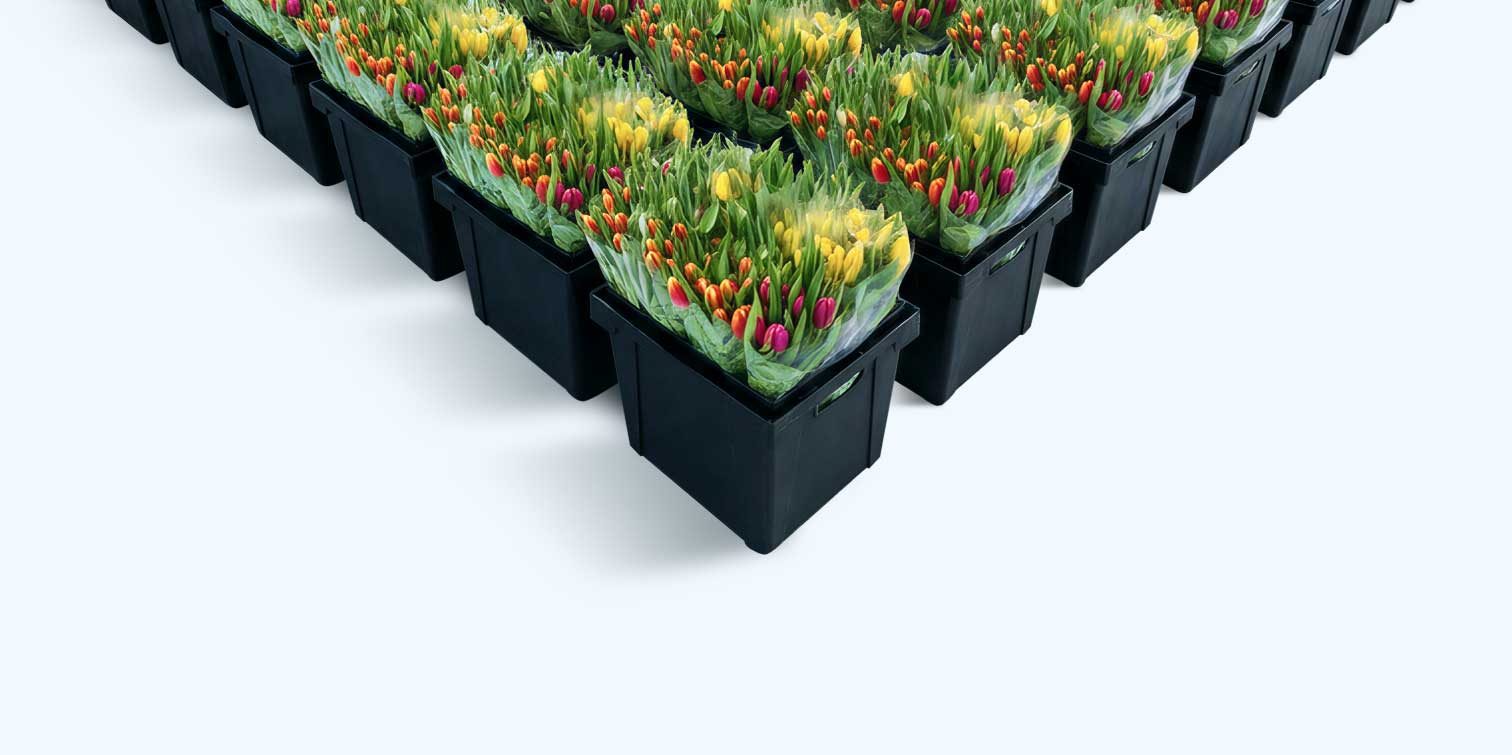
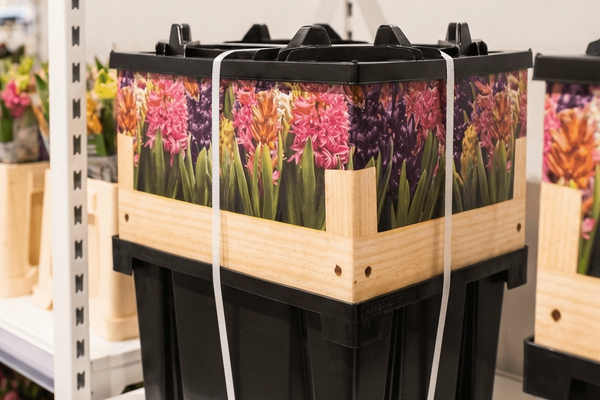
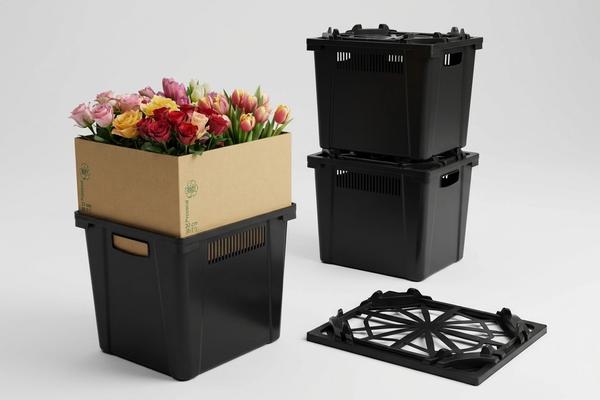
The Container is a sturdy, reusable bucket designed for 80 to 100 or more reuse cycles. It holds water to keep flowers fresh throughout the entire journey. The rectangular shape optimizes space, unlike the round buckets commonly used elsewhere. Made from 50% recycled material.
The Collar is a protective ring that supports flower stems and prevents damage during transport. Available in cardboard or plastic (plastic lasts approximately 50 reuses). Can be customized with company branding and comes in various heights (18cm, 25cm, 35cm) for different stem lengths.
The Lid is a stackable lid with ventilation openings for air circulation. Locking nubs ensure stable stacking on pallets. It allows visual inspection without unpacking and lasts 80 to 100 reuse cycles.
The system also includes optional display units (Madeira, Pico, Bali) for retail environments where Procona containers fit directly with no repacking required. Learn more about our retail solutions.
Procona models explained
The Valencia is the workhorse model, best for growers, exporters, importers, and wholesalers who need maximum bulk transport efficiency. Available in 25cm and 35cm heights with a 30 x 40cm footprint, it is reusable 80 to 100 times. View the Valencia product page for full specifications.
The Amsterdam is built for intensive internal use in nurseries and pooling operations. Same 30 x 40cm footprint but designed for unlimited reuse cycles with heavy-duty construction. See the Amsterdam specifications.
The London was designed specifically for British retail. At 30 x 33cm, it fits perfectly on retail carts and display pallets. Available in 25, 30, and 35cm heights. Explore the London model.
The Florida is the compact option for supermarkets, florists, and small bouquets. At just 24 x 30cm, it is easy to handle and display. Available in 18, 25, and 35cm heights. See the Florida details.
The numbers: single-use packaging vs. Procona
Let us compare the real costs head-to-head. This is not just about the purchase price of a single container. It is about the total cost across your entire operation over time.
Purchase frequency
With water boxes, you buy new packaging for every single shipment. With Procona, you invest once. The containers return to the start of the supply chain, get cleaned, and go again. Over 80 to 100 cycles, the per-use cost drops to a fraction of any disposable alternative.
Structural integrity
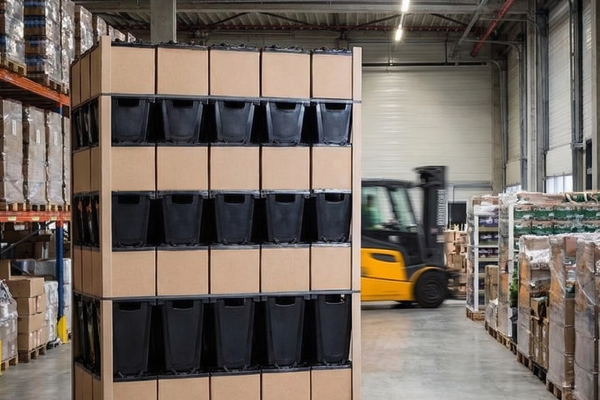
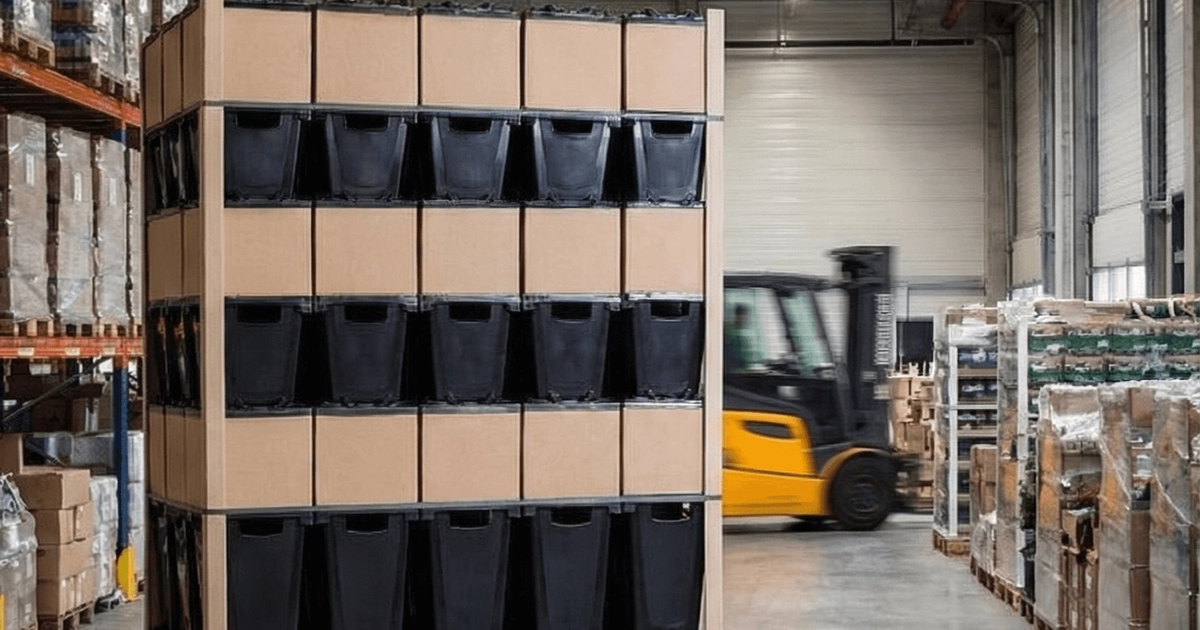
Cardboard water boxes collapse under weight, especially when wet. They cannot support heavy loads on top. Procona containers are rigid and stackable. You can stack heavy products like beer crates or potato bags directly on top of loaded Procona pallets without any damage. That is the kind of structural performance no single-use option can match.
Pallet loading efficiency
Round buckets fit 12 per Europallet layer. Procona rectangulars fit 13 per layer, an 8% improvement that compounds across every truck, every route, every week. Over a year, that means roughly 25% more flowers per pallet, fewer trucks on the road, and lower carbon emissions.
Flower damage rates
Procona users consistently report approximately 4% less flower waste compared to traditional packaging. That is 4% more sellable inventory from the same harvest. For a grower shipping millions of stems, the value of those saved flowers is substantial.
Long-term cost trend
Single-use packaging is a constant expense that only goes up with raw material prices. Procona cost per use decreases with every cycle. By the time you have used a container 50 times, you are paying pennies per shipment. By cycle 80 or 100, the economics are overwhelming.
Where exactly do you save at each step?
In the distribution center
- Standardization: One container system in different heights simplifies your entire operation. No more managing dozens of different box sizes and types.
- Extreme stability: You can stack heavy products directly on top of loaded Procona pallets. Try that with cardboard.
- Labor savings: More flowers per pallet means fewer pallets to handle, fewer forklifts runs, and faster throughput.
During transport
- Ventilation through container and lid keeps flowers fresh even on a fully loaded pallet.
- Better temperature and humidity control compared to sealed cardboard.
- No transport damage from collapsed or wet boxes. No soggy cardboard on the warehouse floor.
- Perfect stacking with optimized pallet utilization on both Euro and block pallets.
In the store
- No unpacking damage: Flowers arrive ready to display directly from the shipping container.
- Faster setup: Procona unpacking is quicker and easier than dealing with wet, falling-apart boxes.
- Peak day handling: The system handles high-volume periods like Valentine's Day and Mother's Day with ease.
- Clean retail environment: No water spillage on floors. No soggy cardboard in the back room.
- More flowers per square meter: The rectangular shape maximizes your display area.
For retailers, Procona containers fit directly into display systems like the Madeira, Pico, and Bali. Explore our solutions for retailers.
The sustainability advantage
Cost-effectiveness and sustainability go hand in hand with Procona. The circular economy model means you are not just saving money, you are eliminating waste.
- Containers and lids: 80 to 100 or more reuse cycles.
- Plastic collars: Approximately 50 reuse cycles.
- Material composition: 50% recycled material.
- End of life: 100% recyclable.
- Waste generated: Zero.
Learn more about our commitment to sustainability and how we measure environmental impact.
Who manages and owns the Procona pool?
There are three main models for managing a Procona pool:
- Supermarket-owned pool: The retailer owns the containers and manages the return logistics. Common with large supermarket chains that have established reverse logistics.
- Supplier-owned pool: The exporter or distributor owns the containers. They control the quality and flow of containers through their supply chain.
- Third-party pooling service: A specialized service provider manages the container pool, handling cleaning, maintenance, and logistics for multiple users.
Automatic washing machines are available for high-volume operations. The right model depends on your volume, supply chain structure, and preferences. Our team can help you determine the best approach for your operation.
30+ years of proven performance
In 1992, Jan de Pagter observed that cut flowers were losing significant quality during their journey from producer to consumer. Working from his garage in Dinteloord, Netherlands, he developed a better solution: a reusable bucket system designed to keep flowers in water throughout the entire supply chain.
That solution became Procona, and the design has remained fundamentally unchanged for over three decades. Why? Because it works. A Procona from twenty years ago still stacks perfectly with one made last week. If the design needed improving, it would have changed. The fact that it has not changed is proof that it was right from the beginning.
Read the full Procona journey, from a garage in the Netherlands to a global standard.
Summary: The Procona advantage
- Sustainable, reusable, and 100% recyclable: Zero waste packaging.
- Packaging cost savings: 80 to 100+ reuse cycles eliminate ongoing packaging spend.
- Transport cost savings: Approximately 25% more flowers per pallet.
- Labor savings in store: Retail-ready, faster setup, no repacking.
- Labor savings in DC: Standardization and extreme stackability.
- Reduced flower waste: Approximately 4% less damage.
- Better presentation: More sales from fresher, better-looking flowers.
Ready to reduce costs and improve quality?
The first step is a conversation. Our team will help you understand how Procona can work within your existing supply chain, what volumes make sense for your operation, and how quickly you can expect to see returns on your investment.
Get in touch with our team for growers, or explore solutions for retailers and distributors.